

cPanel Getting Started Guide
Updated 6 days ago
cPanel is your hosting control panel: from there, you manage your site, domains, email, databases, files, and backups. This guide walks through the current cPanel interface (Jupiter theme, version 138) with screenshots of the panel, and explains the new Meridian interface at the end.
How to access cPanel
You can access it from the mi.duplika.com customer area or directly from your browser using the cpanel. subdomain followed by your domain.
Log in to mi.duplika.com with your username.
Visit your list of services and click the desired account.
Click the Log in to cPanel button.
Your service activation email contains your username and password. Access details are available in How to access the cPanel control panel.
The cPanel interface (Jupiter)
The home screen is called Tools and is organized into three areas: the top navigation bar, the left sidebar, and the list of tools grouped by category.
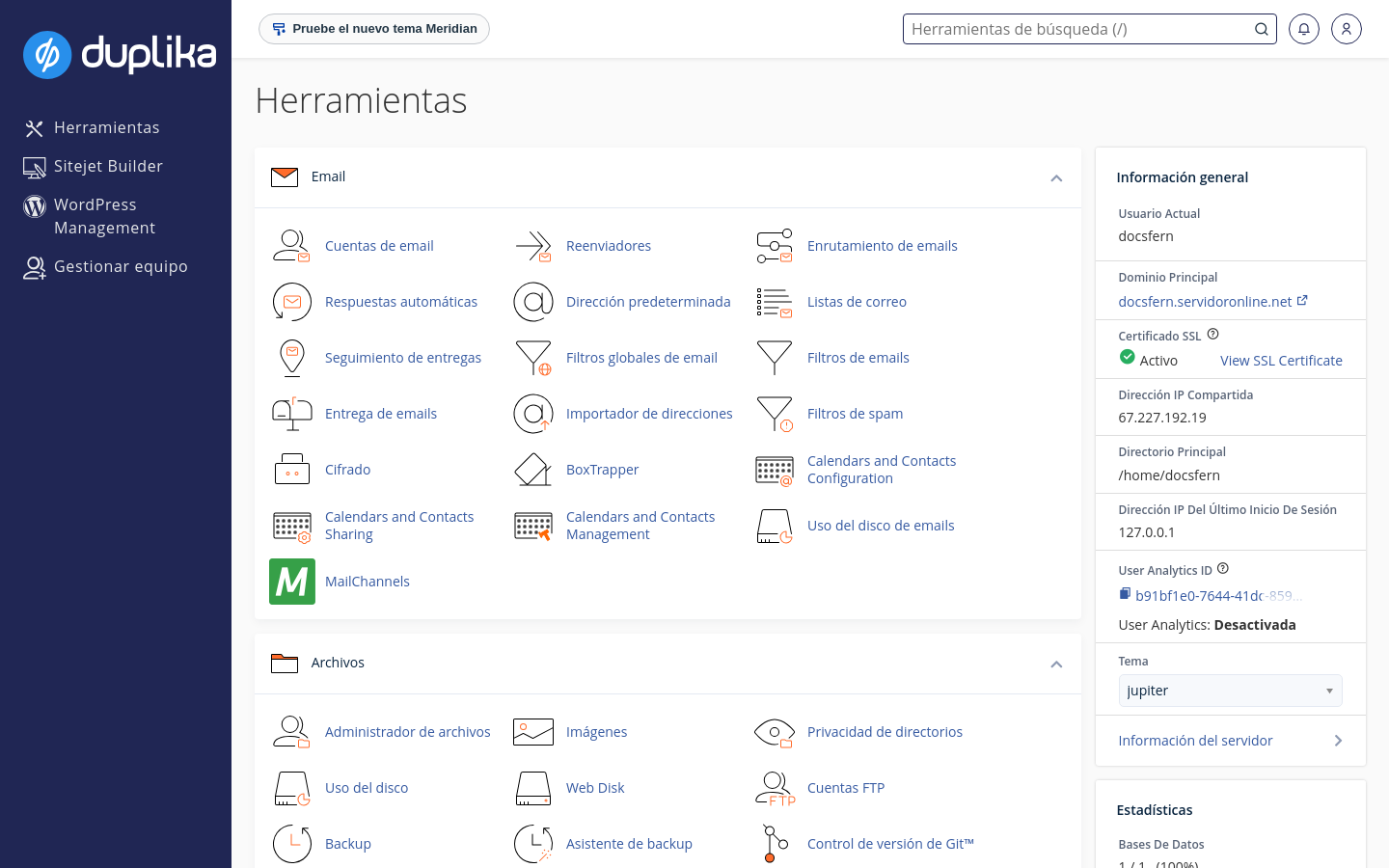
The top bar contains:
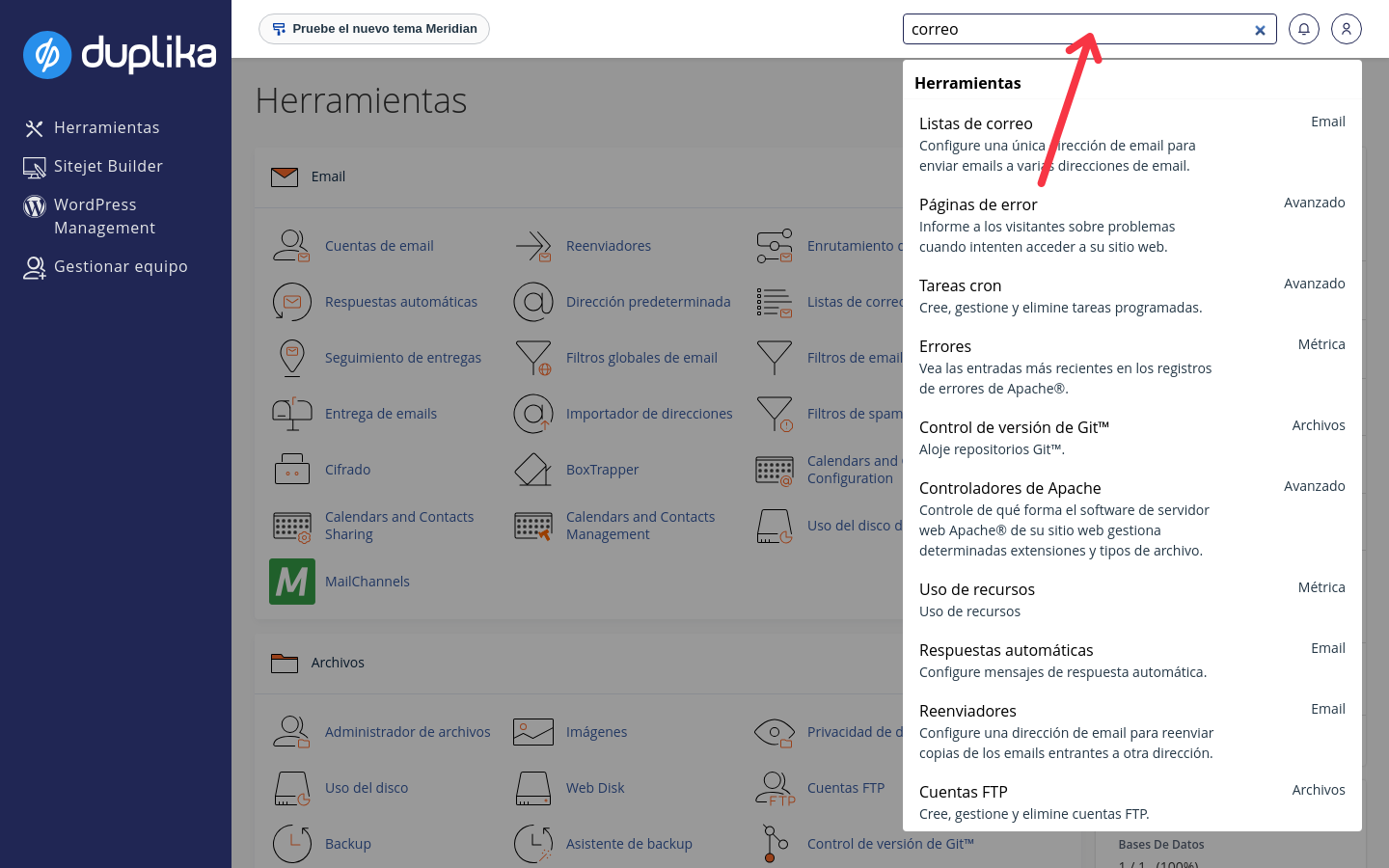
The top-bar search box: enter the name of a tool and cPanel displays it immediately, indicating the group it belongs to.
The system notifications bell.
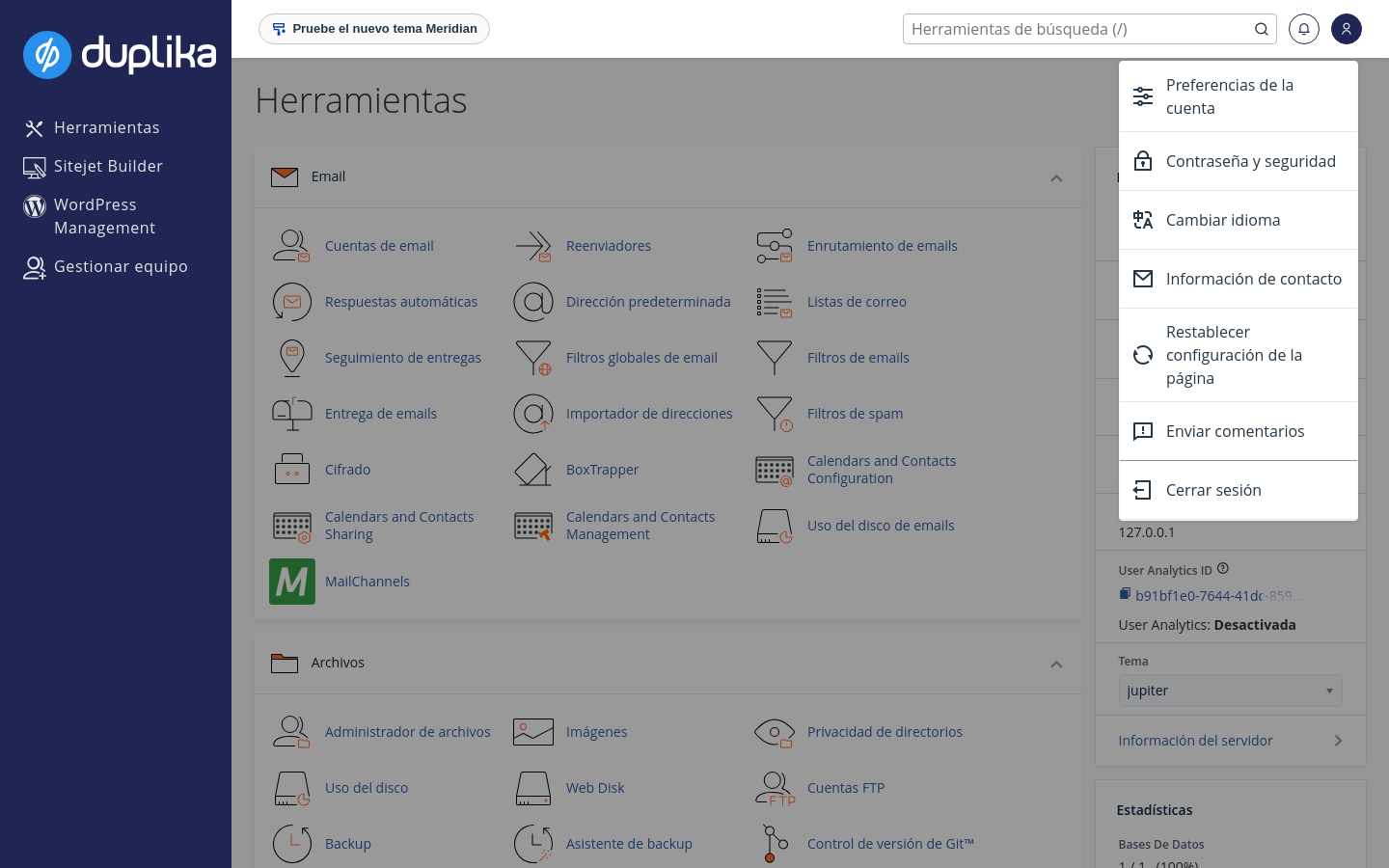
The user icon, with your account menu.
The left sidebar has four fixed shortcuts: Tools (the home screen), Sitejet Builder (site builder), WordPress Management (WP Toolkit), and the shortcut for managing the account team. The center of the screen groups tools by category, such as Email and Files. On the right, the General Information panel shows the current user, primary domain, SSL certificate, shared IP address, home directory, and the panel's active theme; account usage statistics appear below.
The user icon in the upper-right corner opens the account menu: from there, you can access account preferences, change the password and language, update contact information, reset page settings, and log out.
Organizing the home screen
Each tool group can be collapsed using the arrow in its heading, so you only see the categories you use every day. You can also rearrange the icons: drag a tool and drop it elsewhere, and cPanel saves that layout for your next sessions.
Account preferences
Account Preferences contains the panel's personal information and settings. Open it from the user icon menu.
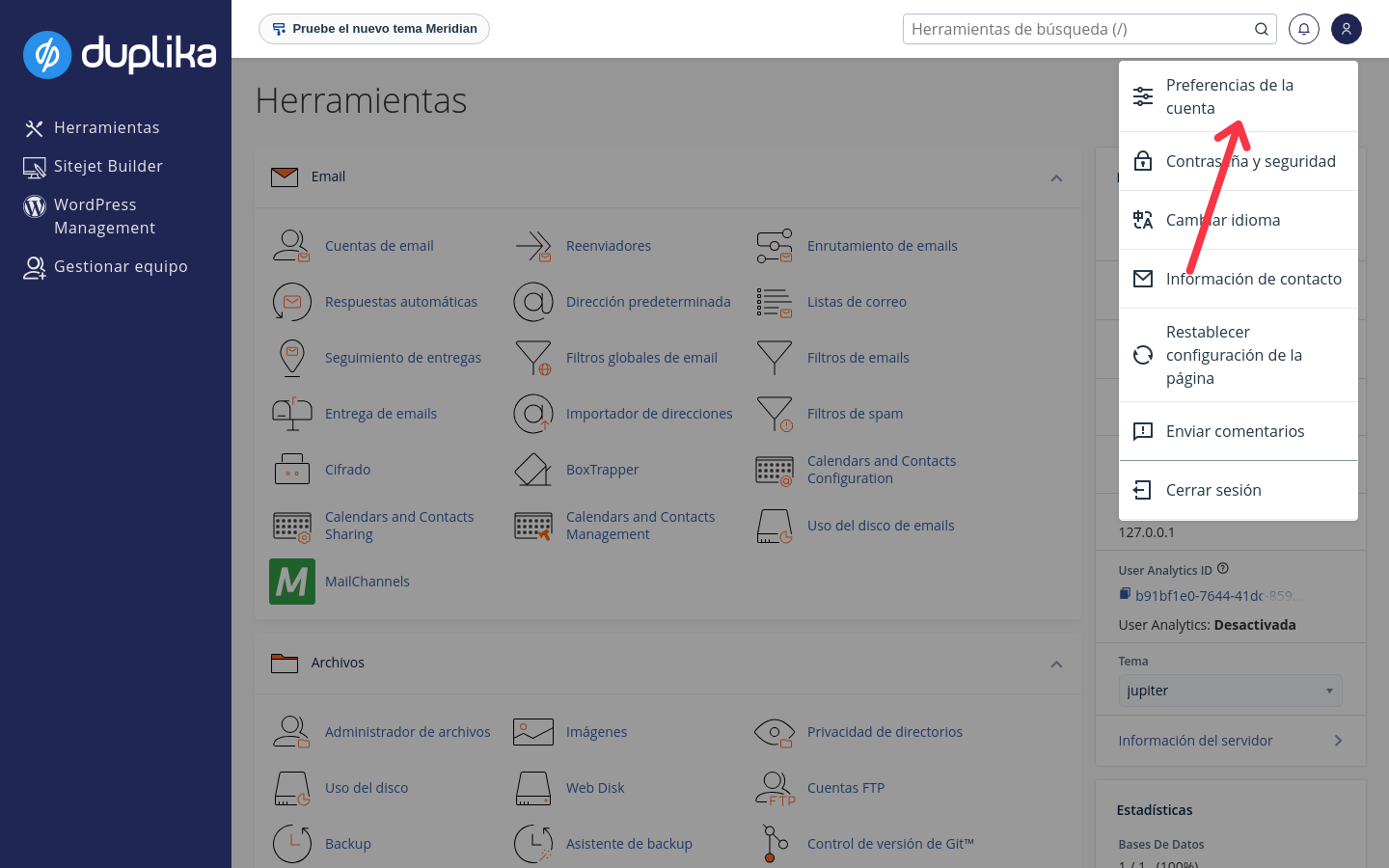
Click the user icon in the upper-right corner.
Choose Account Preferences.
From there, you can update your contact information, the email address where you receive account notifications and password reset confirmations, and the panel language. The password is changed through the password and security shortcut in the same menu.
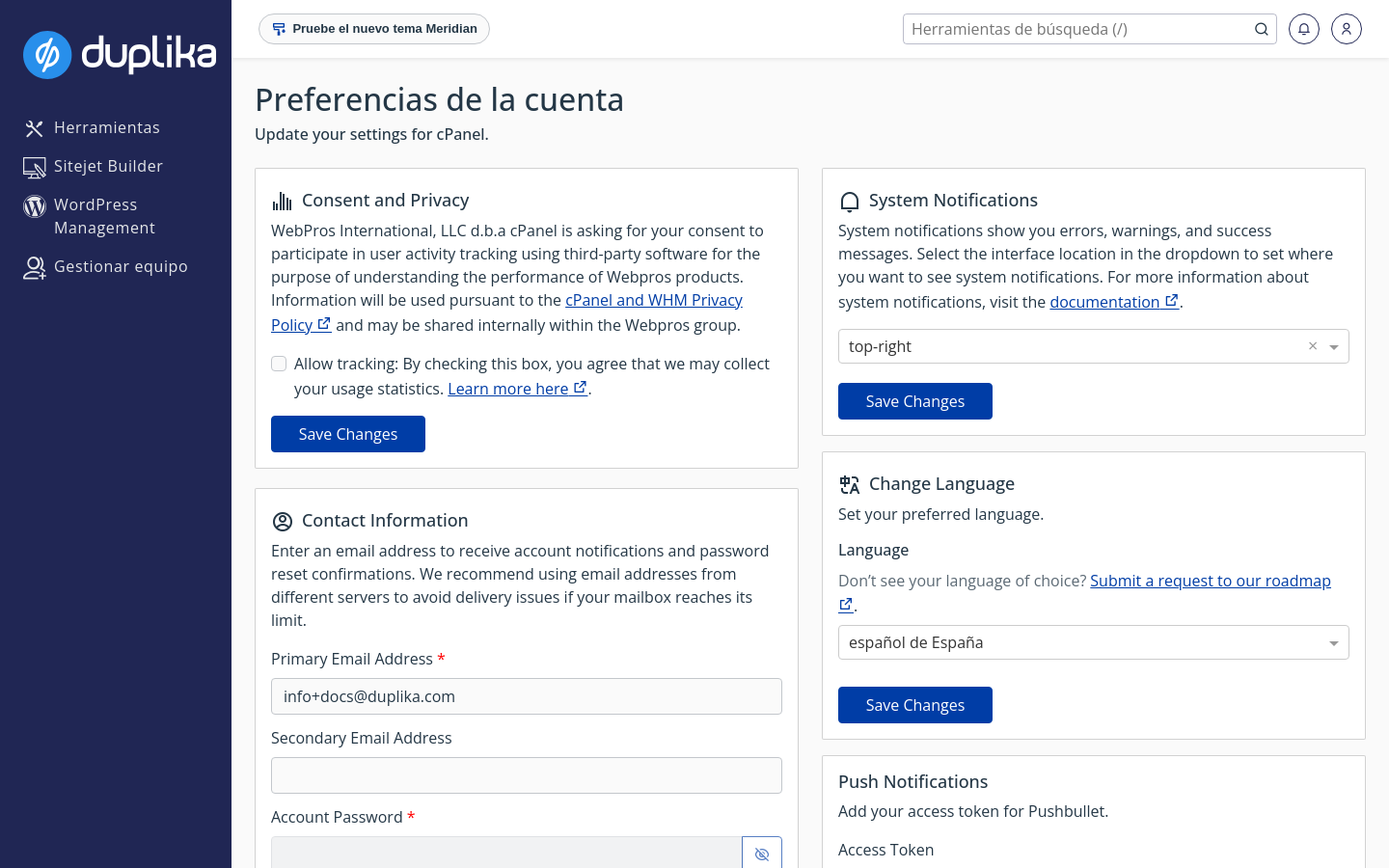
In Contact Information, it is best to use an email address from another server, separate from your own hosting mailbox: if the mailbox reaches its limit, you will still receive the notifications.
If you lost access, follow the steps in How to get a new password for your hosting account.
Domains
The Domains tool manages all the account's domains. Open it by typing domains in the search box, or from the Domains group on the home screen.
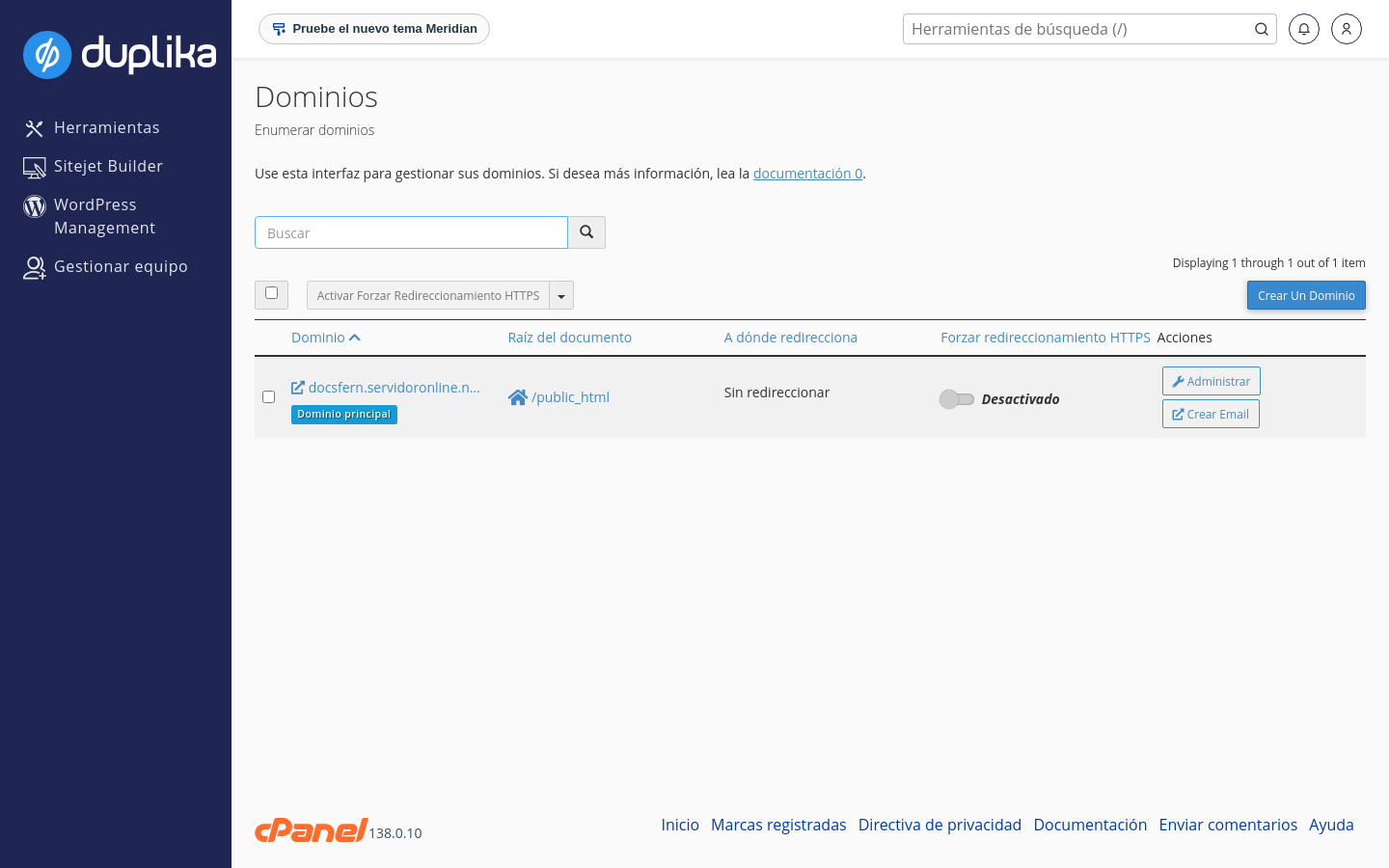
The list shows each domain with its document root (the folder where its files are stored), where it redirects, and whether it forces HTTPS redirection. The account's primary domain is marked with the Primary Domain label. The button for creating a domain adds an additional domain to the plan, while Manage lets you adjust the selected domain.
The Email group contains all email tools: accounts, forwarders, filters, and autoresponders, among others.
Creating an email account
In the search box, type Email Accounts and open the tool.
Click Create.
Enter the username, domain, and password, and adjust the storage if needed.
Click Create to confirm.
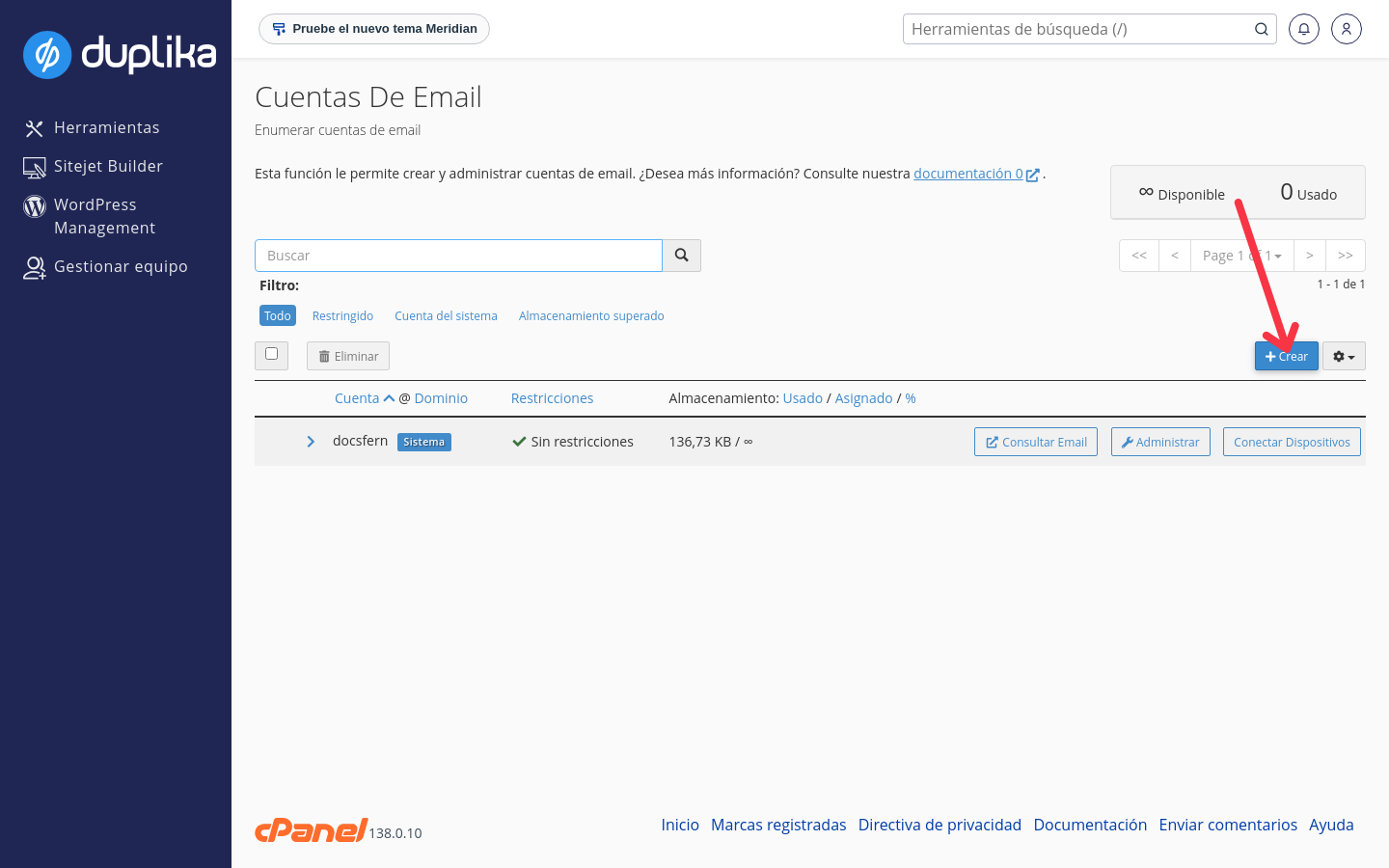
The same page shows each mailbox with its storage and buttons to open that mailbox's webmail, manage it, and obtain configuration details for computers and mobile devices. Complete management is covered in Managing and configuring mail accounts.
Forwarders
Forwarders send a copy of every email that arrives at one address to another mailbox. Create a forwarder for an individual email address or one for the entire domain, and choose whether to keep a copy in the original mailbox or deliver the message only to the forwarded destination.
Spam Filters
The Spam Filters tool activates Apache SpamAssassin for the account. When an email exceeds the configured sensitivity score, the system marks it as spam; the default threshold is 5.0, and a lower number filters more aggressively.
Address Importer
The Address Importer bulk-loads email accounts or forwarders from a two-column file: for accounts, address and password; for forwarders, source and destination addresses. This is useful when migrating email from another provider.
File Manager
File Manager works with the site's files from the browser, without using FTP. Open it from the Files group or with the search box.
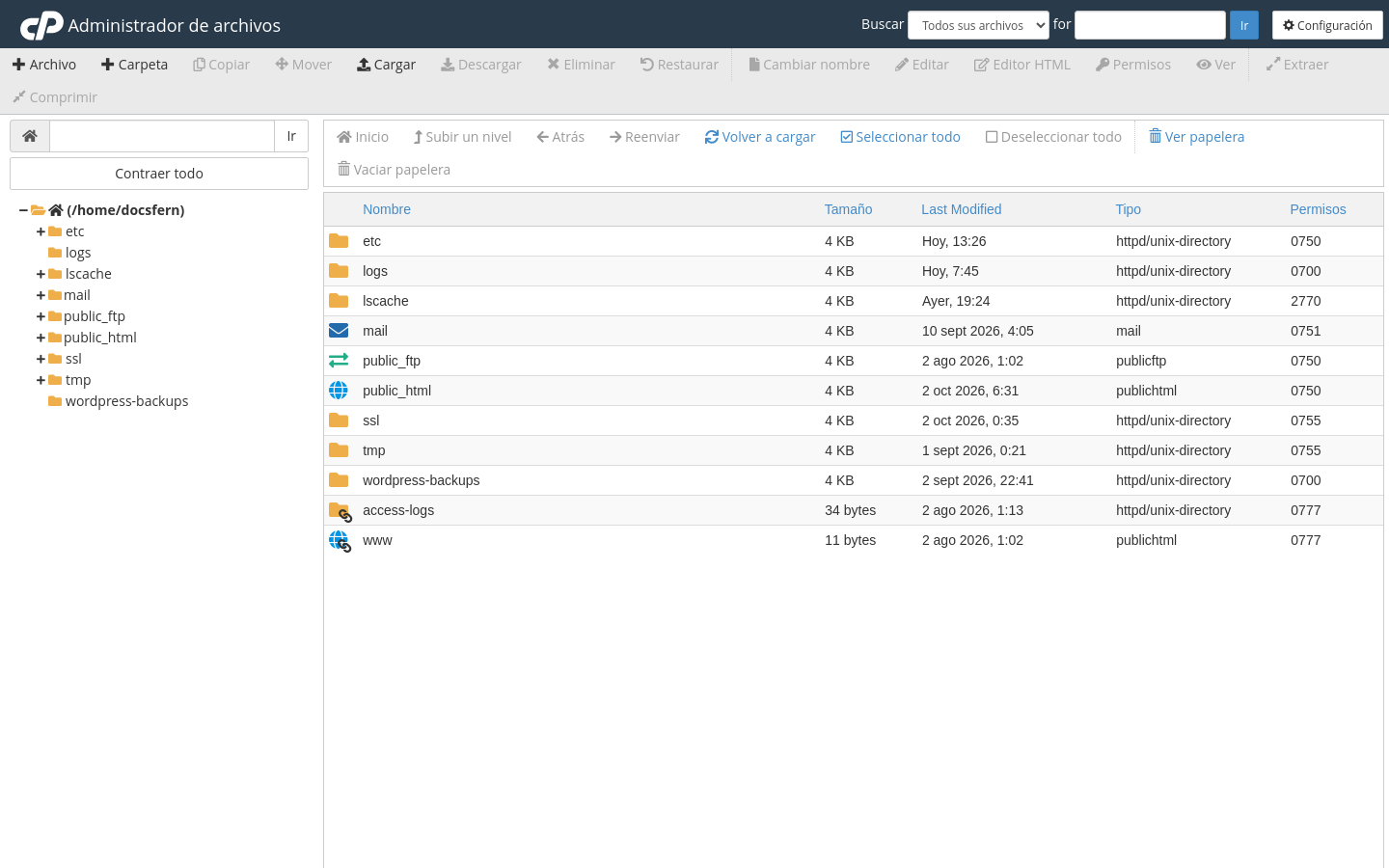
The public_html folder is the document root of the primary domain: upload the website there. From the top bar, create files and folders with File and Folder, upload content with Upload, and use Download, Rename, Edit, and Permissions on selected files. The folder tree on the left expands using the + sign next to each directory.
FTP Accounts
The FTP Accounts tool (in the Files group) creates FTP users with access to a specific folder. Define the username, password, and directory they can access, and the account will be ready to use from an FTP client.
Disk Usage
Disk Usage shows how much space each account folder occupies and the total used against the plan quota. The page breaks down directories such as public_html, mail, and databases, with the total at the bottom.
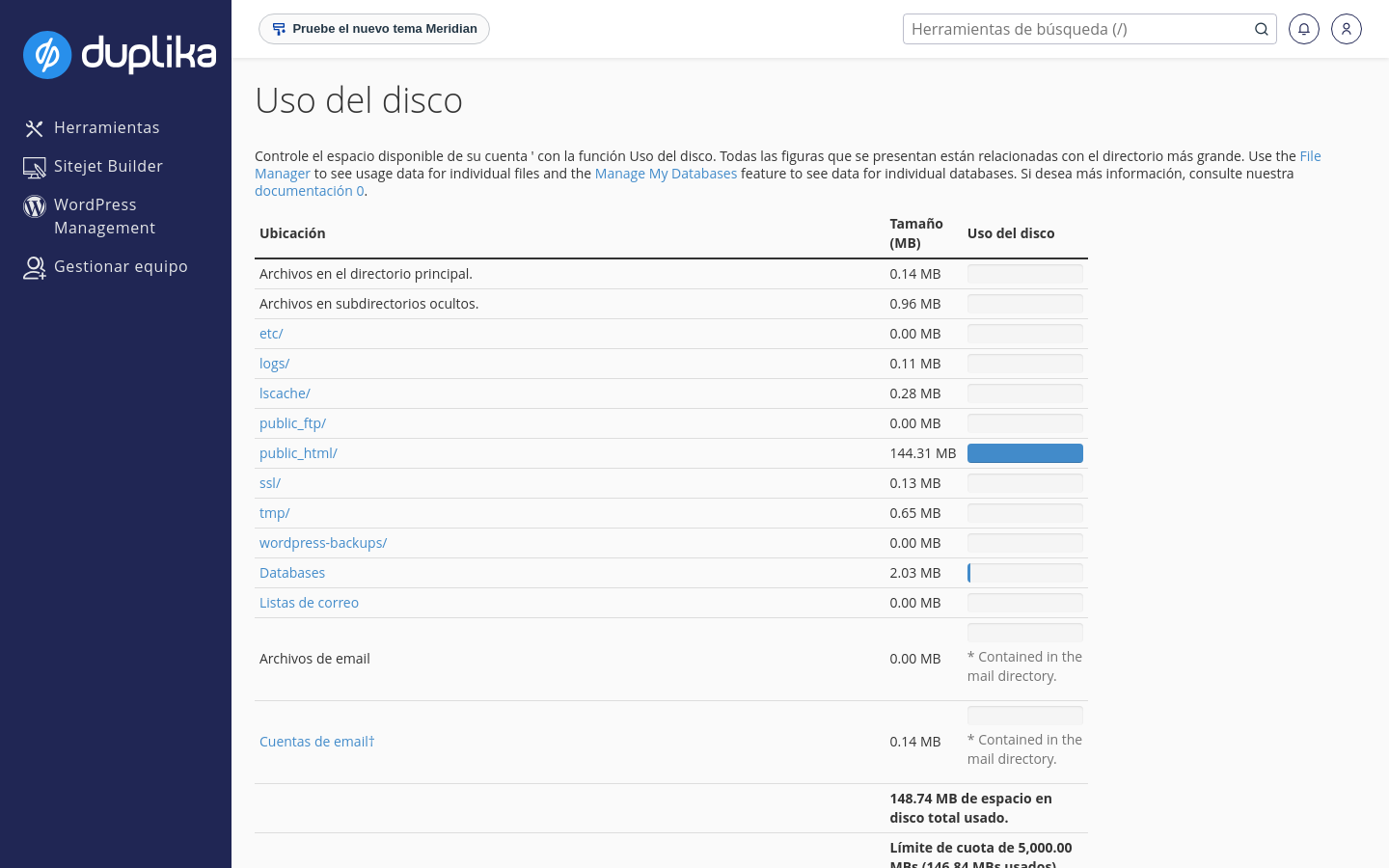
To understand each category and free up space, see Disk Usage Details.
Databases
The MySQL Databases page (search for mysql in the search box) manages the account's databases. The form for creating a database registers the new database; the list of current databases shows their size, users with privileges, and actions for renaming or deleting them. The maintenance section lets you check and repair a database.
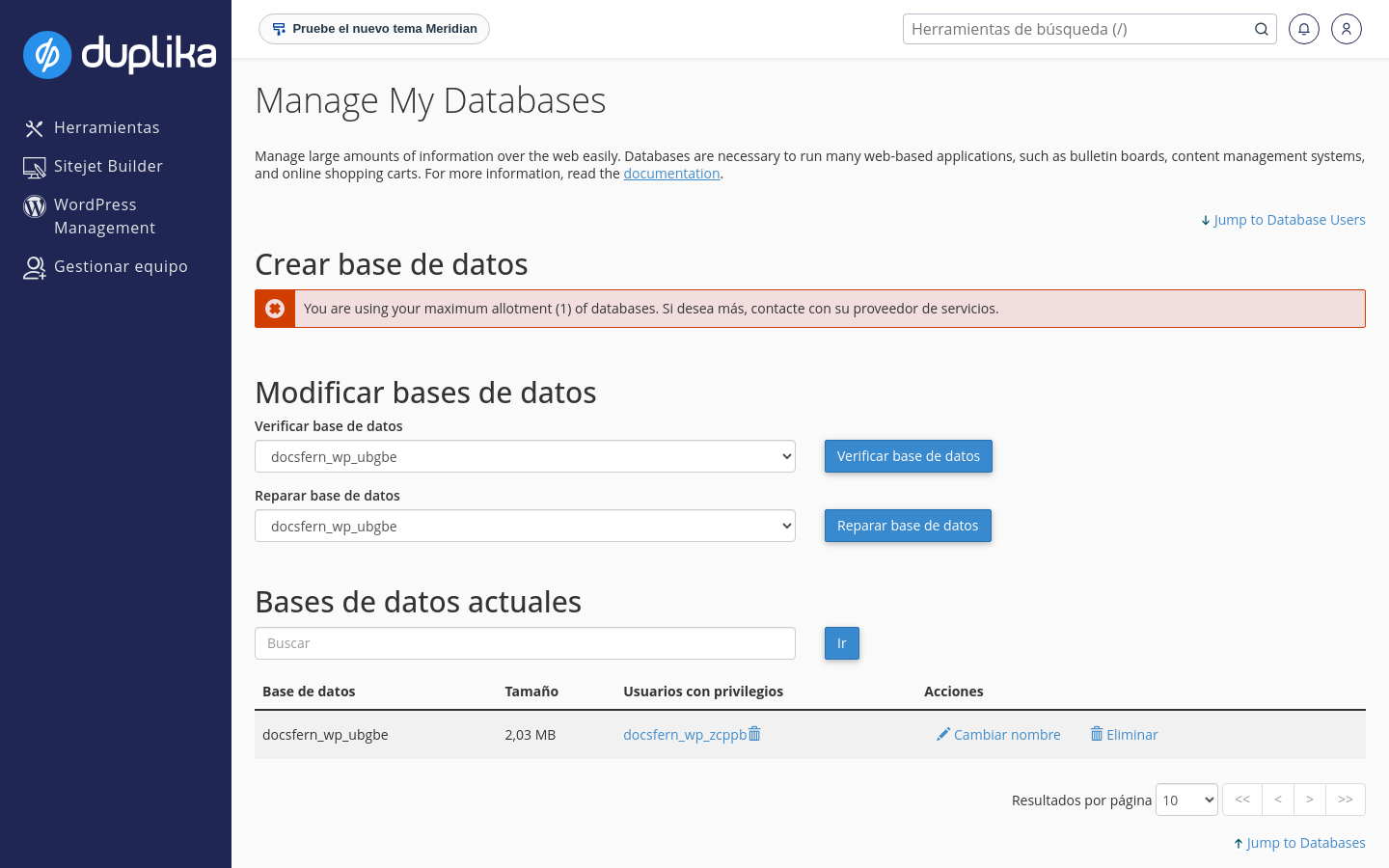
Backups
cPanel offers two backup tools: Backup, which downloads or restores complete backups, and the Backup Wizard, which guides you through the process step by step. Both are in the Files group.
The Backup Wizard proceeds in three steps:
Choose whether to create a backup or restore an existing one.
Choose between a full account backup or a partial one containing only the home directory, databases, or email configurations.
Generate the file and download it to your computer.
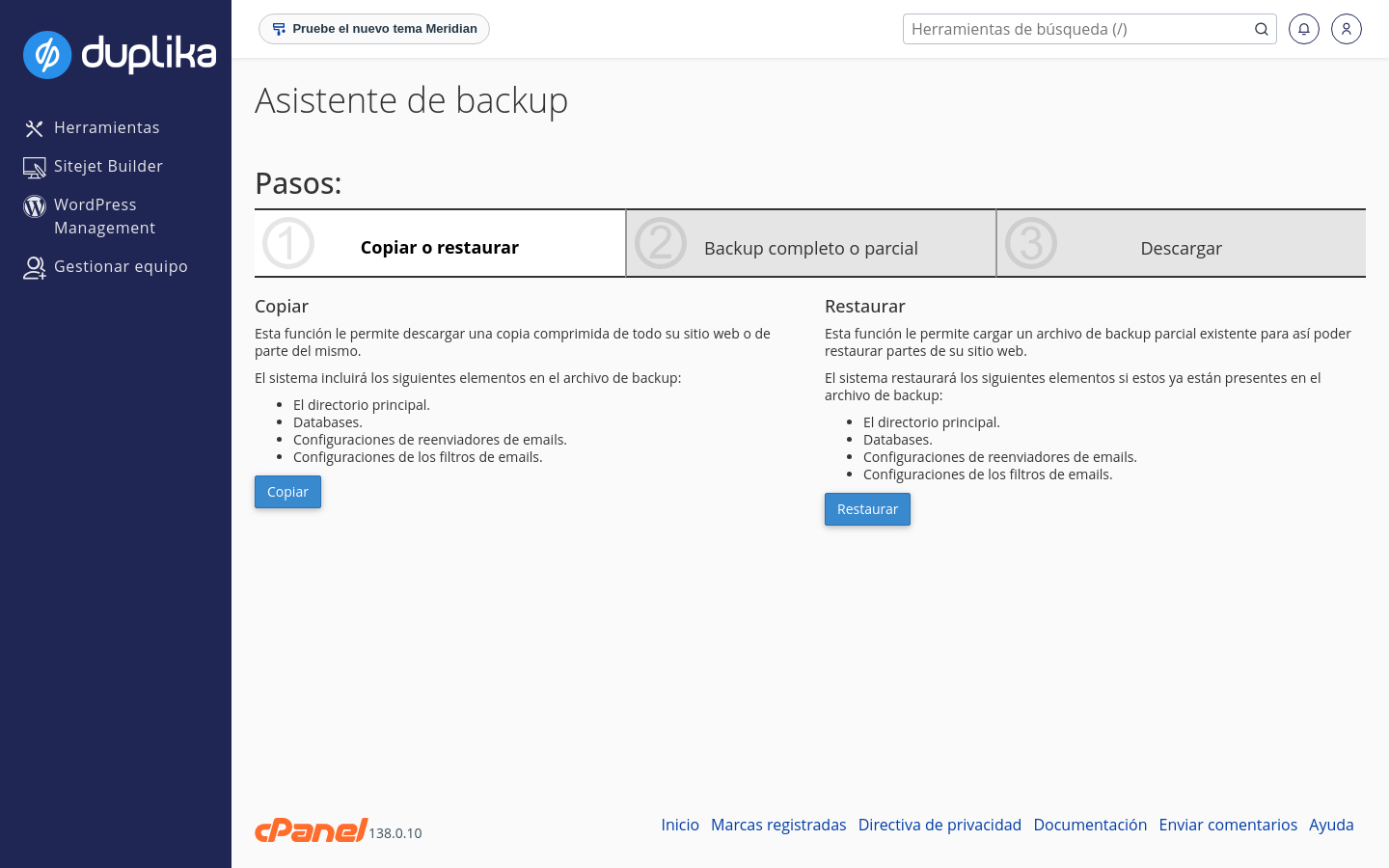
A complete Backup Wizard backup includes the home directory, databases, and forwarder and email filter configurations. In addition to these manual backups, Duplika performs automatic daily account backups; management is available in Automatic backups and restores.
Installing applications with Softaculous
The Softaculous Apps Installer is included in the panel: search for softaculous in the search box to open it. From there, you can install WordPress and dozens of applications with one click, and manage existing ones, including installations, pending updates, and application backups.
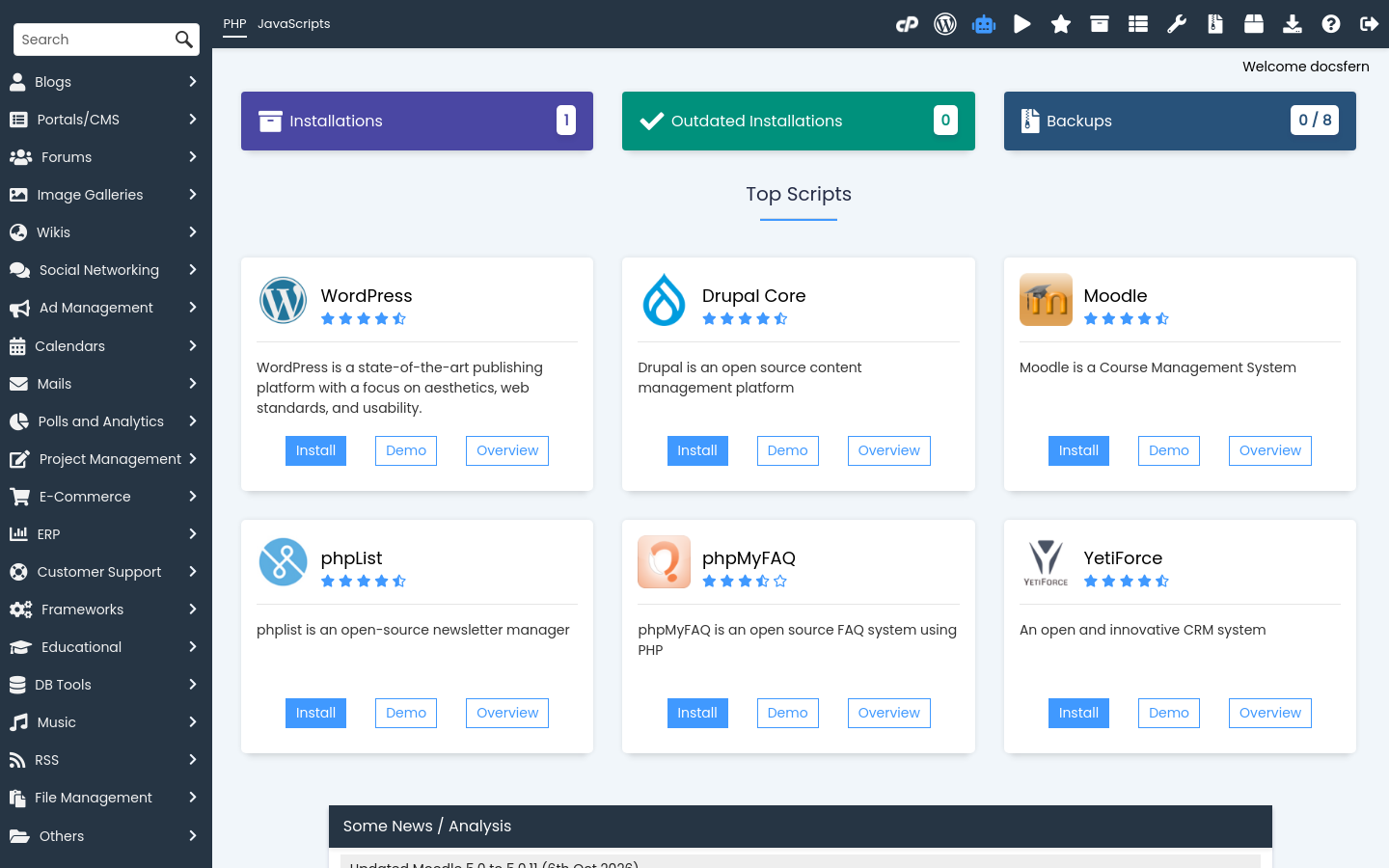
The Softaculous interface is displayed in English. For WordPress specifically, follow How to easily install WordPress and How to access WordPress from Softaculous.
WordPress Management (WP Toolkit)
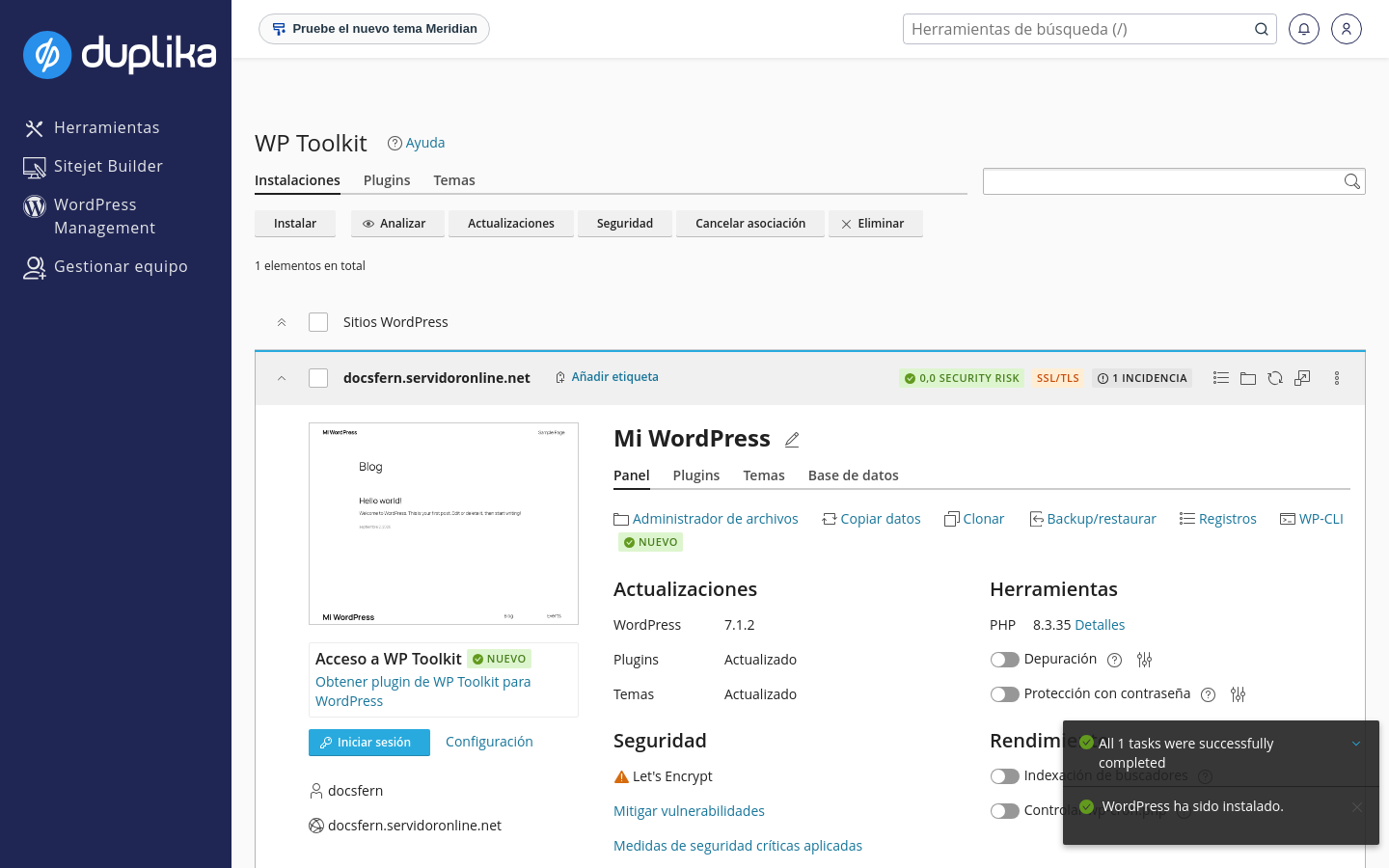
The WordPress Management shortcut in the sidebar opens WP Toolkit, the panel's WordPress manager. It displays each installation with its version, security status, and updates, and lets you install new WordPress instances, update the core, plugins, and themes, and adjust security from a single screen.
The new Meridian interface
Meridian is the new cPanel interface, available starting with version 138. On Duplika's cPanel plans, it is activated from Jupiter using the Try the new Meridian theme button at the top of the panel, next to the logo.
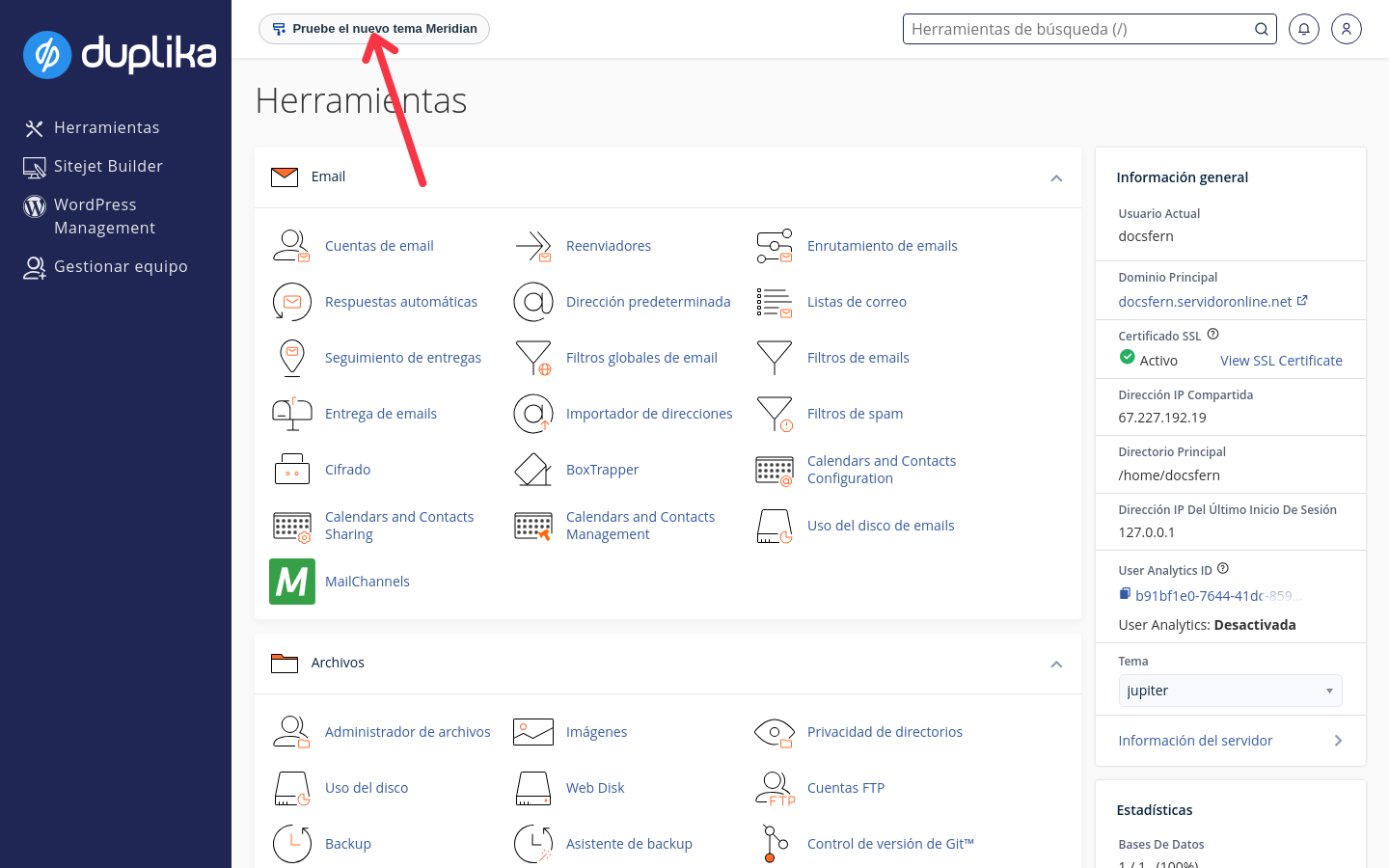
Trying Meridian only changes the panel's appearance: it does not modify the site, email, or databases, and you can return to Jupiter at any time.
Meridian reorganizes the panel around a home dashboard and a sidebar menu with the main sections: Dashboard, Websites & Applications, Email, Files, Databases, Security, and Application Installer.
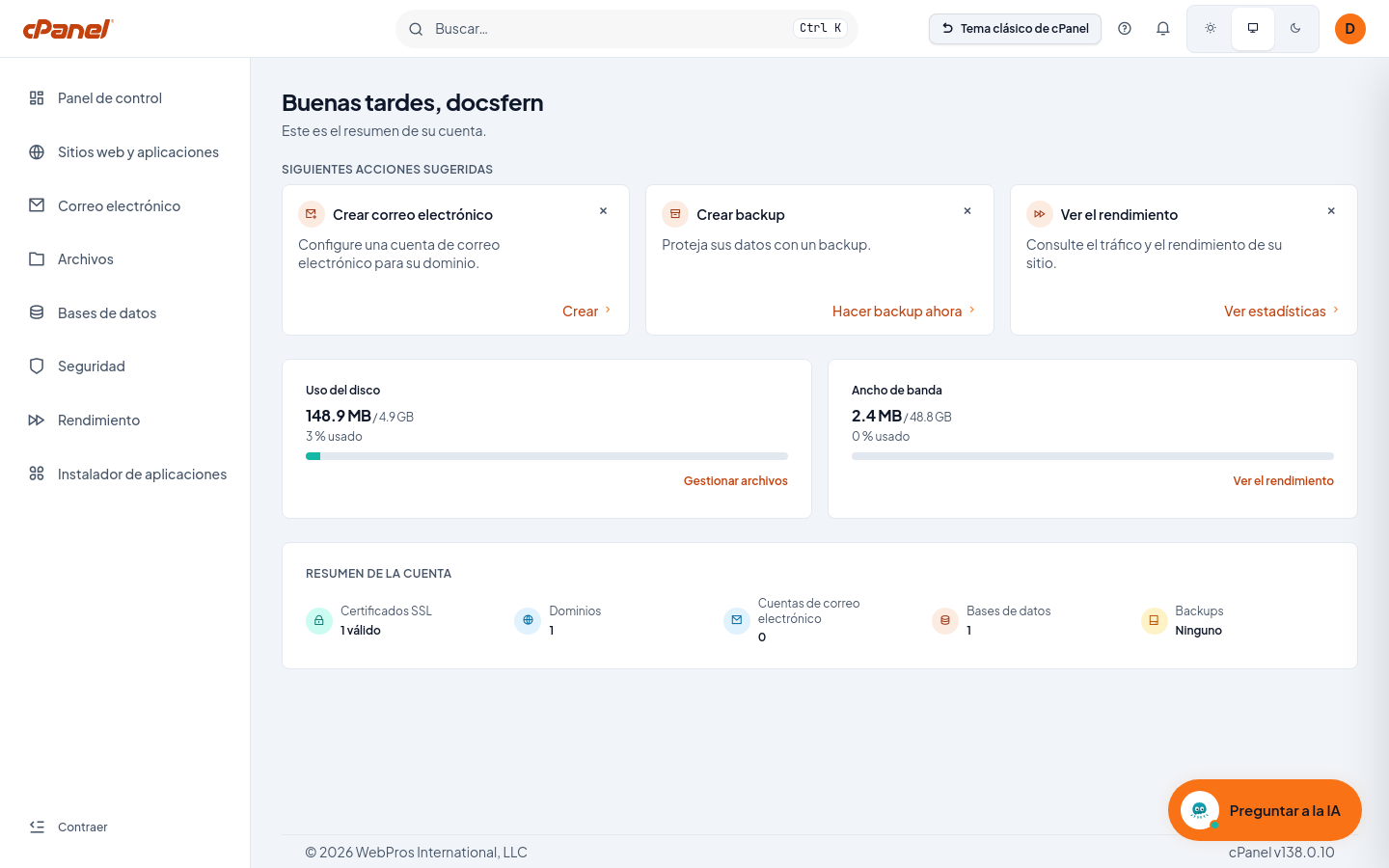
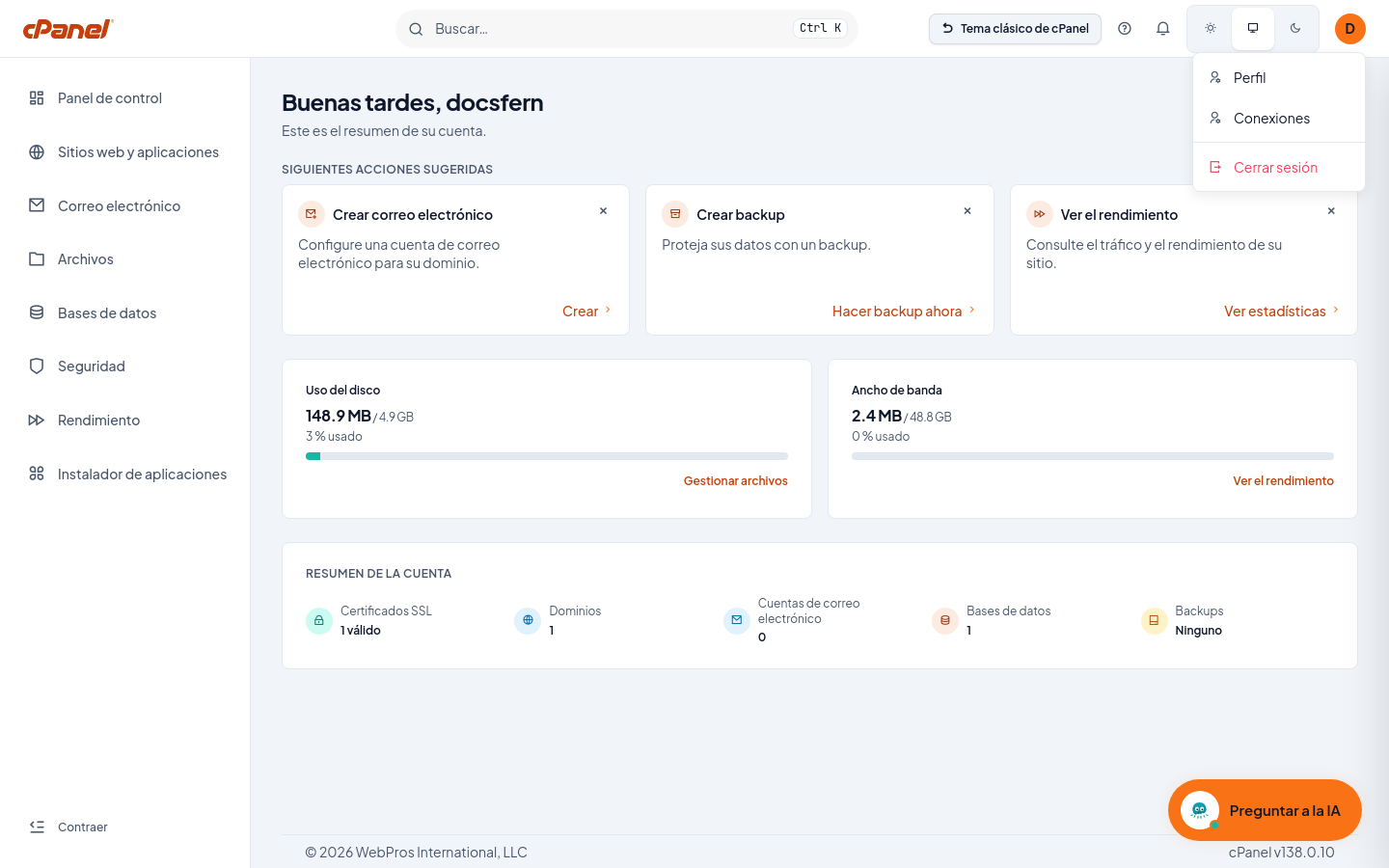
The home dashboard summarizes the account: suggested actions (create email, create a backup, view performance), the Disk Usage and Bandwidth bars, and the Account Summary with SSL certificates, domains, email accounts, databases, and backups.
Searching with the Command Palette
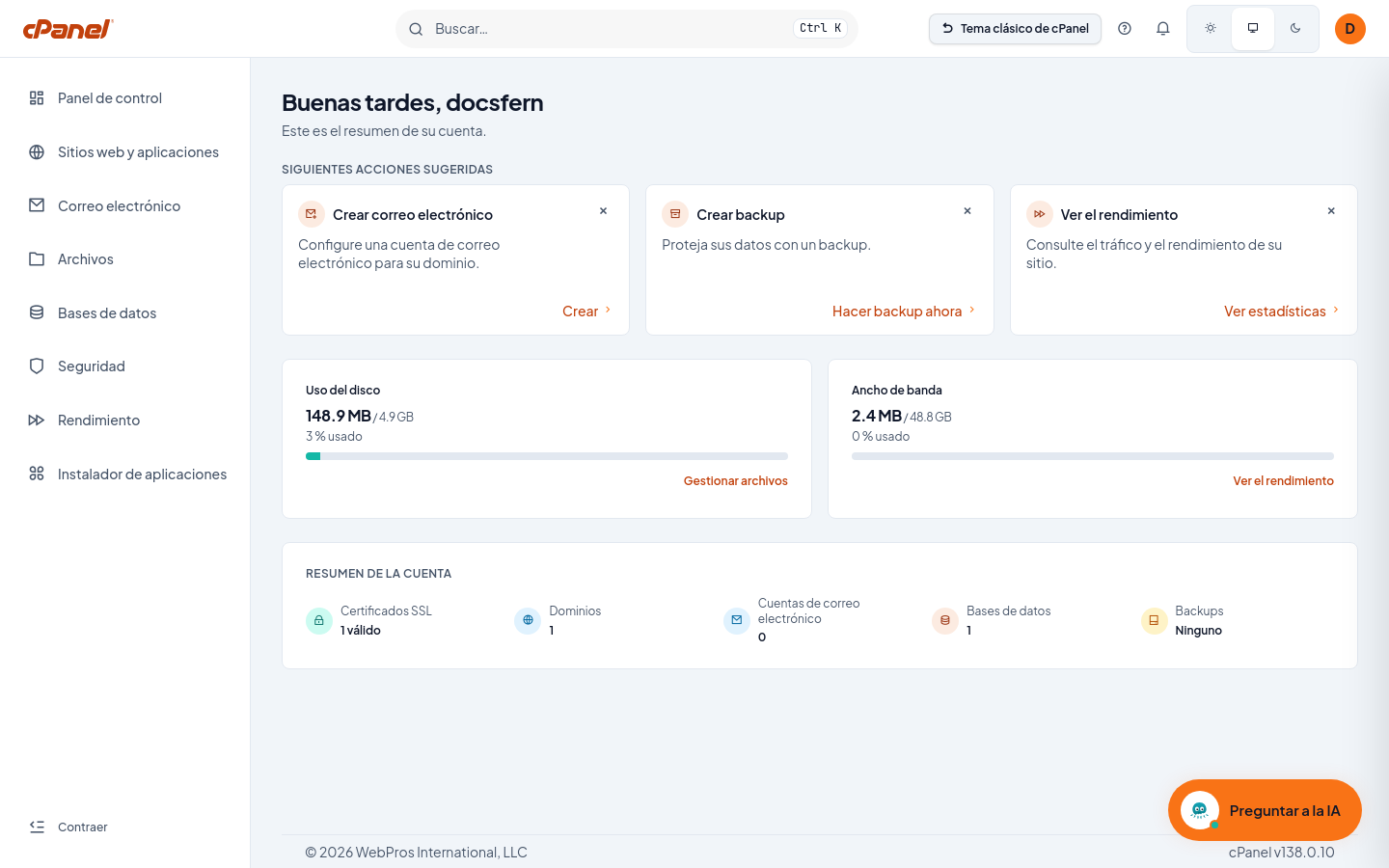
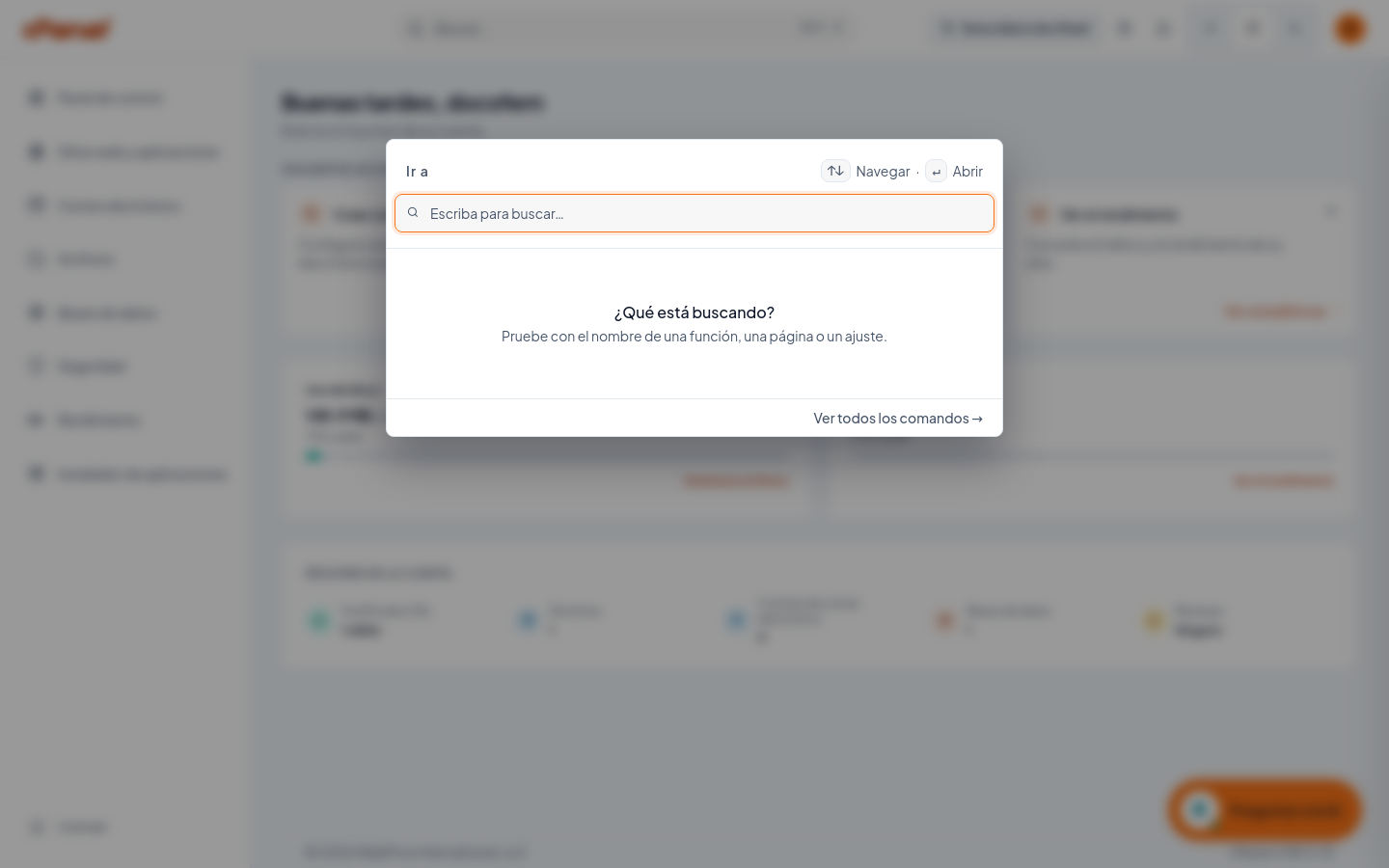
The top-bar Search box opens the Command Palette, which finds functions, pages, and settings throughout the panel. It can also be opened with Ctrl+K (Cmd+K on Mac) or by typing the / character on the keyboard.
The top bar also contains help, notifications, and display preferences, with light and dark modes. The user avatar menu contains Profile, Connections, and Log out.
Return to Jupiter
To return to the classic interface, click cPanel Classic Theme in Meridian's top bar.
The default theme is defined by the provider. Existing accounts in Jupiter can switch between both themes from their own panel; an account created directly in Meridian, however, cannot return to Jupiter on its own.